
Beyond Numbers: ESG and Tech Are Redefining Accounting

I am a Student in the Tax Accounting Study Program at Pamulang University, with an interest in and desire to deepen my knowledge of accounting and taxation.
·waktu baca 3 menit


Tulisan dari AL GHIFARI RAMADHAN tidak mewakili pandangan dari redaksi kumparan
 Perbesar
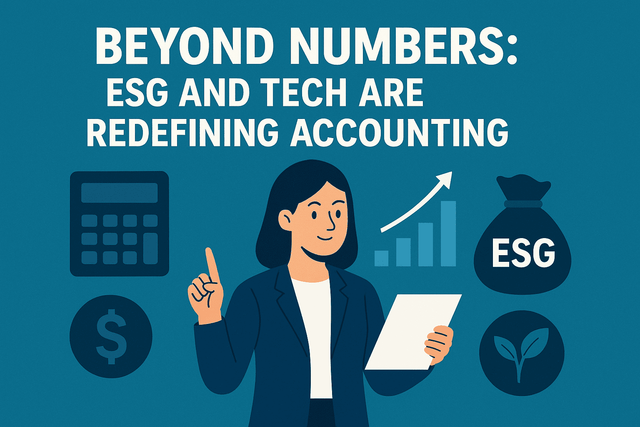
In 2025, the accounting world is undergoing a profound transformation. Once defined by balance sheets and income statements, the profession is now expanding beyond mere numbers. Accounting is no longer just about recording financial outcomes it’s about interpreting the social and environmental impact behind them. The hottest topic today is the integration of ESG (Environmental, Social, and Governance) reporting, which challenges companies to be transparent not only about financial performance but also about how they treat people and the planet.
This shift arises from a global demand for more ethical and sustainable business practices. Major corporations, both domestic and international, are increasingly required to comply with sustainability reporting standards set by institutions like the International Sustainability Standards Board (ISSB). In other words, traditional financial reporting is no longer enough. Investors, regulators, and the public now want to know: How environmentally responsible is a company? How fairly does it treat its workers? How sound and ethical is its governance?
Yet, behind this noble vision lies a complicated reality. Many organizations and professionals still struggle to adapt. Not all are ready to handle complex, non-financial data or to redefine the meaning of accountability. Some critics argue that the ESG trend is overly idealistic, potentially obscuring the core purpose of accounting: delivering objective, reliable financial information. Their concern is valid poorly executed ESG reporting can easily devolve into greenwashing, where companies exaggerate sustainability claims to polish their image rather than drive real change.
Amid these tensions, Generation Z emerges as a key force. Raised in the digital age and deeply attuned to social and environmental issues, this generation brings a unique blend of technological fluency and ethical awareness. They don’t just want to work they want their work to matter. For them, accounting is not merely a technical discipline but a moral one, grounded in transparency, accuracy, and integrity. Generation Z has the potential to bridge the gap between financial data and human values.
Technology further accelerates this transformation. Artificial Intelligence (AI) and data analytics are revolutionizing auditing, reporting, and fraud detection. Cloud accounting enables real-time transparency and efficiency. But these tools are only as honest as the people who use them. Here lies the critical role of young accountants: not merely to master algorithms, but to ensure that technology strengthens honesty, fairness, and accountability.
This transformation is far from easy but it is inevitable. Business today is shifting toward a new paradigm: profit is no longer the sole measure of success; sustainability is. Companies that fail to adapt risk losing public trust, while those that embrace this evolution will define the next generation of economic leadership.
The accounting profession now stands at a crossroads. On one side lies the comfort of tradition; on the other, the challenge of relevance in a changing world. Generation Z holds the key to navigating this balance. If they can combine technical precision with ethical clarity and a sustainable vision, accounting will evolve from a language of numbers into a language of responsibility a language that speaks not only to markets, but to humanity and the future we all share.