
The Geopolitical Anomaly of Pax Americana

Undergraduate Student of International Relations at the Sebelas Maret University
·waktu baca 6 menit


Tulisan dari Alfaairo Christiano tidak mewakili pandangan dari redaksi kumparan
 Perbesar
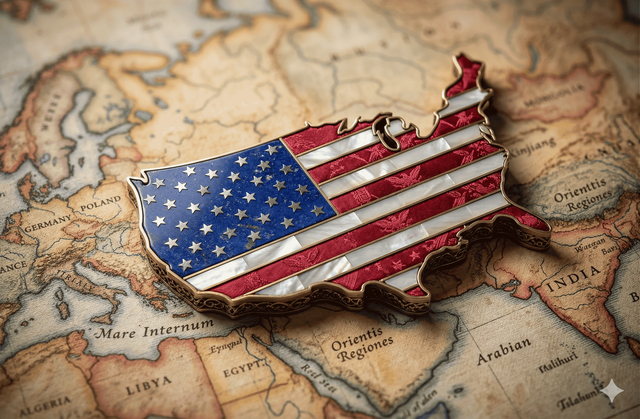
This article is written to analyze something named Pax Americana. Specifically, this article would like to distinguish the pax in its early days and its behavior lately. The focus is to see whether it still reflects its original nature or has shifted into a different form. In doing so, this article also questions the consistency of the Liberal International Order in today’s context.
Pax Americana in Early Days
Plenty of articles talk about how Pax Americana was established with a different approach compared to previous paxes. If we look at Pax Romana, Pax Mongolica, and Pax Britannica, those were built through conventional colonialism. Empires occupied territories beyond their borders and exercised full control over them. This makes earlier paxes strongly associated with territorial expansion and direct domination. Pax Romana was built through Roman expansion across Europe, North Africa, and the Levant. Pax Mongolica followed a similar path, where a powerful empire annexed vast territories and maintained control through military dominance. Meanwhile, Pax Britannica reflected British global supremacy through colonization and economic control over multiple regions. In contrast, many argue that Pax Americana did not rely on direct territorial conquest in the same way.
G. John Ikenberry, through the book titled After Victory, explains the tendencies of powerful states after major wars. He argues that dominant countries tend to maintain their influence, often in the form of hegemony. However, the approach taken by the United States after World War II was relatively different compared to previous empires. Instead of expansion, the U.S. focused on shaping a system that could sustain its influence indirectly. The United States, as one of the winners of WWII, had the capacity to dominate Europe militarily and politically. However, instead of annexing territories, it introduced the Marshall Plan to rebuild European economies. This program helped stabilize Europe while simultaneously strengthening U.S. influence in the region. It shows how influence can be maintained without direct colonial control. Furthermore, the U.S. contributed to the establishment of the United Nations and broader liberal institutions. This led to the creation of what is now known as the Liberal International Order (LIO). According to Ikenberry, the uniqueness of this order lies in how the leading state limits its own power through institutions. This self-restraint is meant to ensure long-term stability and legitimacy.
At the same time, Ikenberry emphasizes that establishing an international order still requires a leading actor. In this case, the United States clearly assumed that role in shaping the LIO. The liberal character of the system reflects U.S. values and preferences in global governance. If the Soviet Union had dominated the process, the system would likely reflect a different ideological foundation.
However, this approach does not necessarily mean the absence of domination. Instead of conventional colonialism, the U.S. uses economic and institutional influence to shape global behavior. The Bretton Woods Agreement is a clear example of this strategy. It positioned the U.S. dollar as the central currency in the global economy and tied other states into a U.S.-led system. This situation can be further explained through the concept of hegemony by Antonio Gramsci. Gramsci argues that dominance can be achieved not only through force, but also through consent and norms. In this case, the U.S. shapes the system so that other states willingly operate within its framework. This makes Pax Americana appear less coercive, but still structurally dominant.
Pax Americana in Nowadays
In recent times, concerns about the decline of the Liberal International Order have become more visible. Ikenberry, once again through his work The End of Liberal International Order?, argues that there is a serious concern about the sustainability of the LIO. He highlights that the challenge is not only coming from rising powers, but also from within the system itself. This makes the current condition of Pax Americana more complicated than before.
Under the first term of President Donald Trump, the U.S. took itself out of several major international agreements and organizations, such as the Paris Agreement, the World Health Organization, and the Trans-Pacific Partnership. These decisions clearly reflected a shift away from multilateralism and a reduced commitment to global cooperation frameworks. Moving into his later political agenda and second-term ambitions, there were also strong indications that the U.S. would further reconsider or withdraw from dozens of international commitments through executive actions and policy revisions. This creates a perception that the U.S., as the leading actor of the Liberal International Order, is no longer fully committed to maintaining the system it once strongly promoted.
In addition, there are claims that the U.S. is reconsidering or weakening its involvement in other institutions. Discussions around reducing commitments to organizations like UNESCO and the UN Human Rights Council have emerged in recent years. This creates a perception that the U.S. is stepping back from global leadership. As a result, the credibility of the LIO is increasingly questioned.
At the same time, U.S. foreign policy also reflects a more aggressive approach. Since the early 21st century, the U.S. has been involved in multiple conflicts such as the War in Afghanistan and the Iraq War. More recent tensions, including confrontations with Iran, further show this pattern. This raises questions about whether the U.S. still acts as a stabilizer or has become more interventionist.
Some argue that these wars are conducted in the name of promoting democracy and maintaining global order. However, others see them as a reflection of classical hegemonic behavior. Instead of relying on institutional influence, the U.S. appears to return to more conventional forms of power projection. This creates a contradiction within Pax Americana itself.
This condition can be seen as a form of backsliding in global governance. The U.S. is acting in ways that resemble earlier empires, despite operating in a modern system. This makes Pax Americana look like a geopolitical anomaly in today’s world. It is neither fully liberal nor fully traditional in its approach.
Author's Note
This article is written purely to express the concern of the author. The author recognizes that the establishment of the LIO, especially through the United Nations, was not solely about domination. The role of other powers such as the United Kingdom and the Soviet Union also contributed to shaping the system. Therefore, it would be inaccurate to say that the U.S. fully controlled the post-war order alone. At the same time, this article acknowledges that there are multiple interpretations of Pax Americana. Some may argue that the system still functions effectively despite current challenges. Others believe that the order is gradually declining due to internal contradictions. The author believes that the reality today speaks louder than any single perspective.