
When Experience Changes Opinion: John Locke and Public Opinion After Gaza

Mahasiswa S2 Media dan Komunikasi UMY, asal Mesir. Tertarik pada komunikasi strategis dan opini publik.
·waktu baca 2 menit


Tulisan dari Mahmoud Sobhy tidak mewakili pandangan dari redaksi kumparan
How do people change Minds ,The English philosopher John Locke gave a simple answer in the 1600s: through experience and evidence.
 Perbesar
In this essay, I use his idea to look at how public opinion changed during the war in Gaza. Locke said that a person's mind begins like a blank page. We are not born with ready-made ideas.
Our knowledge grows from what we see, hear, and learn. For Locke, a good belief must rest on evidence, not on habit or on what we were told before.
This idea helps explain what happened in public opin
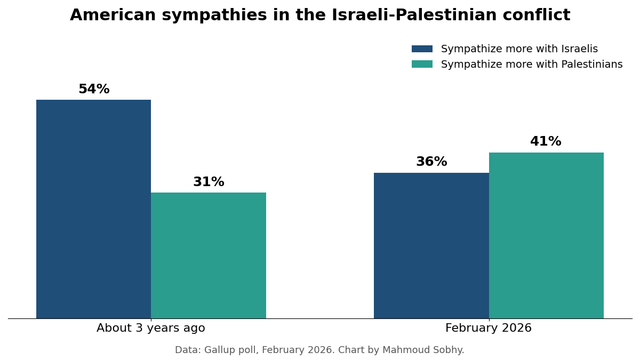
ion. Gallup's 2026 poll found that, for the first time in 25 years of polling, more Americans sympathize with Palestinians than with Israelis. The numbers are 41% for the Palestinians and 36% for the
Israelis. Still, the picture is not one-sided, because 46% of Americans have a favorable opinion of Israel, compared with 37% for the Palestinian territories. (America's slipping sympathy for Israel +2)
We must be careful here. The change did not start on 7 October 2023. Gallup shows that the gap began to shrink in 2019. But the war made it faster: three years ago, 54% of Americans sympathized more with Israelis, compared to 31% for Palestinians. So the war did not create the change. It sped it up. (arabnews) (cfjctoday)
Locke's idea also raises a question for media students. Most people did not live this war themselves. They saw it through social media, news, and videos. Is that "experience" in Locke's sense? I think it is a new kind of experience, a second-hand one. It can give people real knowledge, but it can also mix facts with emotion. Some critics say feelings and images moved
people more than evidence did. That is a fair point. It reminds us that Locke asked for evidence, not only for experience. In conclusion, Locke helps us see that opinions change when people meet new information and new experiences. In the digital age, media is the main door to that experience. So the quality of the evidence we show people matters more than ever. Source: Gallup poll, February 2026 (1,001 U.S. adults, margin of error ±4 points).