
Turning College Life into Poetry

Pecinta linguistik dan dunia pendidikan. Mahasiswa Pendidikan Bahasa Inggris yang gemar mengulik struktur bahasa, metode pengajaran, dan isu-isu literasi.
·waktu baca 7 menit


Tulisan dari Rosseni pasaribu tidak mewakili pandangan dari redaksi kumparan
As an English Education student at UHKBPNP, my daily life is basically a mix of endless assignments, complicated theories, and typical campus drama. Honestly, some things are easy to put into words in an academic setting, but there are moments that just feel better expressed through something more personal and honest.
And that’s exactly how this poem was born.
 Perbesar
This poem was originally written as part of an assignment for my English Literature: Prose, Poetry, and Novel course. But it is not just another college assignment I had to complete for a grade.
For me, it’s really about the process of growing through college: how education shapes our mindset, how we struggle with our own ego, and how the knowledge we gain shouldn’t just stop with us, but actually mean something to others.
It’s a journey from entering college with big dreams, to staying up late over assignments, overthinking everything, getting distracted way too easily, struggling to open up, and slowly figuring out what I’m actually doing all this for.
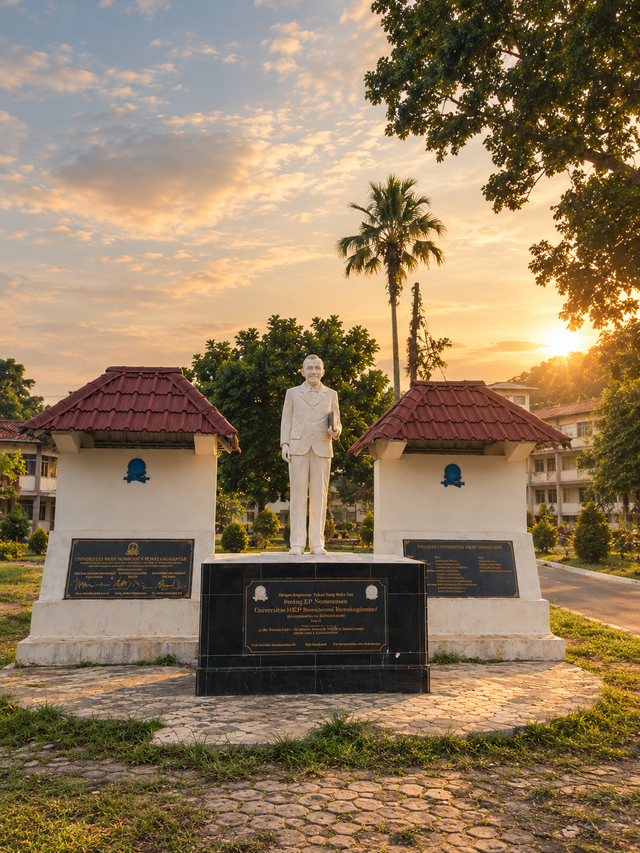
The title PRO DEO ET PATRIA comes directly from UHKBPNP’s motto. For me, it gives this journey another layer of meaning. Education is not only about gaining knowledge, but also about learning how that knowledge can be carried beyond ourselves. For God and for the Country.
Okay so before the actual poem, I gotta say that this class lowkey changed how I see poetry. It's not just what you're trying to say, it's how you say it. The wording, the sound, even how it looks on the page, it all actually means something.
Writing that poem also made me think harder about the language I wanted to use. Although this article is written in English, I chose to write the poem in Indonesian. For me, it feels more natural to express these experiences in the language I use every day, the language that feels closest to my thoughts and emotions.
So, rather than trying to translate those feelings into another language, I wanted to let them speak in the language that feels most like me.
PRO DEO ET PATRIA
Di persimpangan
ada api cita menggelora
asa dan mimpi yang membara
Di sisi lain
Dinginnya realitas membelenggu jiwa
Namun sang pejalan tetap teguh
Mengambil langkah di antara cahaya dan bayangan
Membawa cita yang terus menyala
Percaya bahwa terang
Menanti di ujung perjalanan
Ia menyelami lautan aksara
Yang disemayamkan sang waktu
Pada tiap lembar yang terbuka
Ia mengeja nama-Mu,
Sambil langkahnya mengarungi riuhnya rimba.
Malam menggadaikan sunyinya
Secangkir kopi menjadi saksi
Kepada tiap mata yang enggan terpejam
Tiap lembaran yang mekerutkan kening
Teori menutup pintunya sendiri
Sementara tinta berkali-kali
Menguburkan kalimat yang baru saja dilahirkan.
Langkahnya kadang dipatahkan oleh riuh bayangnya sendiri,
Ketika layar menyulap waktu menjadi serpihan cahaya.
Jemarinya hanya berniat membuka satu jendela,
Namun dunia lain datang mengetuk tanpa henti.
Satu guliran melahirkan guliran berikutnya,
Sementara waktu luruh tanpa disadari
Godaan tumbuh tanpa suara
Kemudahan yang datang secepat sentuhan,
Jawaban yang tiba sebelum pertanyaan selesai,
Pengetahuan yang cukup digenggam sebentar
Lalu hilang sebelum menjadi pemahaman.
Ia tahu, layar dapat menjadi jembatan,
Namun kadang menjelma lorong tanpa ujung;
Membawa begitu banyak dunia ke dalam genggaman,
Hingga ia lupa, ke mana sebenarnya langkah itu ingin bermuara.
Maka ia belajar menundukkan layar, bukan karena takut pada sinarnya, tetapi agar kilau sesaat tak membuatnya lupa pada arah yang ingin dituju.
Ia mengejar cahaya di ujung lorong,
Namun semakin dikejar, semakin panjang gelapnya.
Di tengah riuh yang memanggil namanya,
ia belajar menjadi suara
Di antara suara-suara yang tak pernah kehabisan kata.
Keramaian meminta ia membuka pintu,
padahal di dalam dirinya
Ada rumah yang terbiasa mengunci jendela.
Satu sapaan terasa seperti mengetuk langit,
Satu perkenalan seperti menyeberangi jurang
Tanpa tahu di mana harus meletakkan kaki.
Ia ingin menjadi bagian dari lingkaran,
Namun setiap lingkaran terasa seperti dinding
yang diam-diam mengukur keberaniannya.
Maka ia meminjam senyum
yang kadang terlalu berat untuk dikenakan,
Menyusun kata-kata di kepala
sebelum membiarkannya keluar dari bibir.
Lucunya, dunia mengajarkan bahwa
Siapa yang diam dianggap tak punya cerita,
Seolah keberanian selalu harus menjerit
agar layak disebut keberanian.
Malam merekonstruksi semuanya
Tawa, jeda, tatapan, di kepala.
Mengira dirinya terlalu asing
Untuk tiap meja yang penuh suara,
Terlalu sunyi untuk percakapan
yang berjalan tanpa jeda.
Sampai akhirnya ia mengerti:
Tidak semua bunga tumbuh
Dengan cara yang sama menuju cahaya.
Ada yang mekar di tengah keramaian,
Ada yang memilih halaman yang teduh.
Barangkali keberanian bukan tentang
Menjadi orang lain di tengah kerumunan,
Melainkan tetap menjadi diri.
Sambil perlahan membuka pintu.
Barangkali begitulah belajar:
Menyalakan api dengan tangan yang terbakar.
Mengejar pagi melalui malam,
Belajar bersuara meski bergetar, dan menemukan bahwa
Jalan menuju terang sering kali
harus melewati diri sendiri.
Ilmu tak berhenti di wacana,
Ia menjadi suluh yang membakar keangkuhan,
Kian jauh ia menapaki jalan, semakin ia kecil di mata langit.
Dan kelak, ketika gerbang itu ditinggalkan,
langkahnya akan beranjak menuju dunia,
Membawa apa yang pernah ditanamkan
Di antara lembar, ruang, dan perjalanan.
Sebab apa yang tumbuh di tempat ini
tak seharusnya berhenti di balik gerbang yang sama.
Wahai pengembaraan
Yang takkan pernah usai,
Jika pada akhirnya harus bermuara pada selembar pengakuan:
Untuk apa semuanya ini?
Maka biarlah jawabnya tertulis di sana,
Bukan untuk kemegahan diri,
Melainkan Pro Deo et Patria
Untuk Tuhan dan Ibu Pertiwi.
After writing the poem, I started to understand more clearly why poetry feels different from ordinary writing. A poem does not only communicate an idea or an experience. The way the words are chosen, arranged, repeated, and connected can also become part of the meaning.
This is where Roman Jakobson's concept of the poetic function becomes relevant. Jakobson explains that the poetic function focuses attention on the message itself, particularly on the relationship between the words that are selected and the way they are combined. In poetry, words are not simply chosen because they have a certain meaning. Their sound, position, repetition, contrast, and relationship with other words can also shape how the message is experienced.
In my poem, this can be seen through the use of metaphor and personification. Instead of describing college life directly, I use images and figurative expressions to represent experiences such as ego, distraction, doubt, and the pressure of academic life. This allows abstract experiences to become something more concrete and imaginable.
The choice of words also matters. I intentionally avoided making every line sound like an explanation. Some ideas are expressed indirectly, allowing the reader to interpret the meaning rather than receiving it as a straightforward statement. In this way, the language itself becomes part of the experience that the poem is trying to communicate.
Another important element is repetition and contrast. Certain words or images are repeated or placed against one another to emphasize the tension within the speaker's journey. There is a contrast between ambition and doubt, knowledge and ego, distraction and purpose, as well as the world outside and the inner world of the speaker.
The arrangement of the lines also contributes to the poem's meaning. A poem does not have to explain everything in complete sentences. Sometimes, a pause, a shortened line, or a particular placement of a word can create emphasis that would not have the same effect in ordinary prose.
Therefore, Jakobson's poetic function helps me understand something I learned through this assignment: in poetry, how something is said can be just as meaningful as what is being said. The experience of college may be the subject of my poem, but the language, images, sounds, and arrangement are what shape that experience into poetry.
Looking back, I realize that poetry is not simply about arranging beautiful words, but about giving meaning to experiences that might otherwise remain unspoken. Through this poem, I have come to see education as more than a process of gaining knowledge or achieving personal success. It is also a journey of learning humility, understanding oneself, and discovering how what we learn can contribute to something greater than ourselves. This is what *Pro Deo et Patria* means to me: for God and for the country. Ultimately, the knowledge we gain should not end with us, but should become something meaningful that we carry into the world.