
Building a Campus Academic Information System with Java GUI and XAMPP

Mahasiswa S1 Teknik Industri Unissula
·waktu baca 7 menit


Tulisan dari Andhyta AA tidak mewakili pandangan dari redaksi kumparan
 Perbesar
The rapid development of information technology has significantly influenced the way educational institutions manage their academic activities. Universities are expected not only to provide effective learning environments but also to establish reliable administrative systems that support students, lecturers, and academic staff. Activities such as student registration, course enrollment, class scheduling, grade management, and academic record processing require accurate and well-organized information.
However, managing these activities manually can create several challenges. Paper-based documentation and disconnected data files may lead to duplicated records, inaccurate information, difficulties in retrieving academic data, and delays in administrative services. These problems indicate the importance of implementing digital solutions that can simplify academic management and improve operational efficiency.
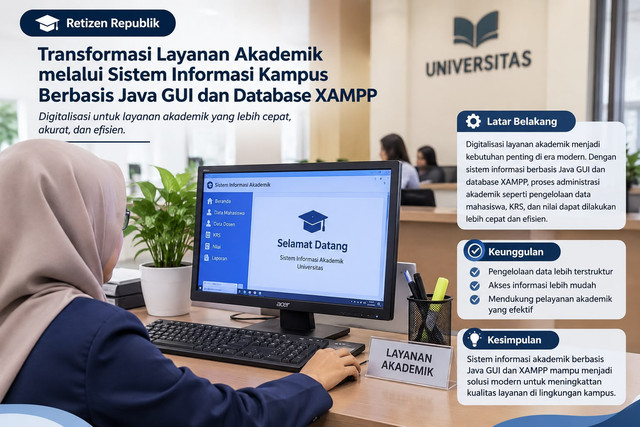
One possible solution is developing a campus academic information system using Java programming, a Graphical User Interface (GUI), and a MySQL database managed through XAMPP. This combination provides a practical example of how programming and database technologies can be integrated to create a desktop application that supports academic administration.
An academic information system is a digital platform designed to collect, process, store, and present information related to educational activities. It functions as a centralized information management system that helps educational institutions organize academic records and provide information to authorized users.
A typical academic information system contains several important components, including student profiles, lecturer information, course databases, academic schedules, course registration records, and student grades. These components are interconnected, meaning that information entered into one part of the system may be required by other functions.
For example, a student's academic record is connected to the courses they have registered for, the lecturers responsible for those courses, and the grades obtained during the semester. Without an organized database, managing these relationships can become complicated.
Therefore, developing an integrated application can help improve data consistency, simplify administrative processes, and make academic information easier to access.
A practical example of this concept is the development of a desktop-based academic information system using Java GUI. The main objective is to create an application that provides a user-friendly interface while maintaining a structured connection to a database.
Java is selected because it supports object-oriented programming and provides various tools for desktop application development. One of its commonly used graphical libraries is Java Swing, which allows developers to create interactive application components such as windows, buttons, text fields, tables, menus, and dialog boxes.
Through Java Swing, the application can be designed with several interconnected pages. Instead of entering commands manually, users can interact with the system through visual elements. This approach makes the application more accessible to users who may not have technical programming knowledge. The proposed campus application can include several main features.
First, a login page is required to verify user identities before accessing the application. Second, a student management module allows administrators to register new students, update personal information, delete records when appropriate, and display existing student data. Third, a lecturer and course management module provides information about academic staff and available subjects.
Another important feature is the Course Registration System, which enables student course selections to be recorded and organized. The application can also include an academic scheduling module and a grade management feature to display class schedules and learning evaluation results.
Each module serves a specific administrative purpose, but all modules are connected through a shared database. As a result, information can be managed within a more consistent environment.
An application requires a reliable storage mechanism to ensure that information remains available after the program is closed. This is where database management becomes essential.
XAMPP is a software package commonly used to establish a local development environment. It provides several components, including Apache, MySQL or MariaDB, PHP, and Perl. It also includes phpMyAdmin, which provides a browser-based interface for managing databases.
In this case study, MySQL is used as the primary database management system, while XAMPP provides the local environment for operating and managing the database service. It is important to understand that Apache is not a mandatory requirement for connecting a Java desktop application to MySQL. Java can communicate directly with the database through Java Database Connectivity (JDBC), provided that the database service is running.
The database structure can consist of several related tables, including student, lecturer, course, registration, schedule, and grade tables. Each table contains specific attributes that represent the information being stored.
For example, the student table may contain student identification numbers, names, study programs, and contact information. Meanwhile, the course table stores course codes, course names, and credit information. Relationships between tables can be established through primary keys and foreign keys to maintain data consistency.
The connection between Java and MySQL is implemented using JDBC. This technology allows the application to execute SQL commands, including INSERT, SELECT, UPDATE, and DELETE. Consequently, information entered through the graphical interface can be processed and stored directly in the database.
The general workflow begins when a user launches the application and enters their login credentials. After successful authentication, the system displays the main dashboard containing the available academic management features.
The user can then select a specific function, such as viewing student records, managing courses, or checking academic grades. When new information is entered, the Java application processes the input and sends an appropriate SQL command through JDBC.
The database receives the request, performs the required operation, and returns the result to the application. The updated information can then be displayed through the interface, particularly in tables or other relevant components.
This process demonstrates the relationship between four important elements: the user, the graphical interface, the Java programming logic, and the database. Each element has a different responsibility but works together to support the overall application.
Before the system is used in an actual academic environment, several testing procedures should be conducted. These include testing login functionality, verifying database connections, checking data input and modification, and ensuring that information is displayed correctly. Testing is also necessary to identify errors that may affect application performance.
The implementation of an academic information system offers several potential advantages. For administrative staff, digital data management can reduce repetitive documentation and simplify information retrieval. For students, academic information can be presented through a more accessible interface. For university management, structured databases can support more consistent academic record management and reporting.
Furthermore, this project provides an opportunity for students to understand how software development can address practical organizational problems. Learning Java programming, database design, and system integration encourages analytical thinking and problem-solving skills.
Nevertheless, several challenges must be considered. One of the most important is information security. Academic records contain important personal and educational information, so access should be restricted according to user roles. Passwords should be stored using secure hashing methods, while database queries should use prepared statements to reduce the risk of SQL injection.
Regular database backups, input validation, and systematic application testing are also necessary. In addition, a local XAMPP environment is more appropriate for development and demonstration. If the application is intended for real campus-wide use, further infrastructure is required, including a properly configured database server, secure network access, maintenance procedures, and reliable data protection mechanisms.
Developing a campus academic information system using Java GUI and an XAMPP-supported MySQL database demonstrates how programming technologies can contribute to the digital transformation of higher education. By integrating a graphical interface with structured database management, academic activities such as student administration, course registration, scheduling, and grade processing can be organized within a single application.
Beyond its technical functions, this project also highlights the importance of understanding user requirements, designing efficient workflows, maintaining data accuracy, and implementing appropriate security measures. A successful information system should not only function correctly but also provide meaningful benefits to the people who use it.
The development of digital competencies is particularly relevant to engineering education. For example, students of the Industrial Engineering Study Program, Faculty of Industrial Technology, Sultan Agung Islamic University (Universitas Islam Sultan Agung), can explore how information technology supports organizational efficiency and systematic process management. Further institutional information is available at unissula.ac.id, while prospective students can access admission information through pmb.unissula.ac.id.
Ultimately, an academic information system is more than a computer application. It represents an effort to establish a more organized, accessible, secure, and efficient educational administration environment. Through continuous development and evaluation, this type of technology can become an important foundation for universities adapting to the demands of the digital era.