
BRICS Expansion 2025: Global Order Transformation and Multilateralism Challenges

Mahasiswa S-1 Hubungan Internasional Fakultas Ilmu Sosial dan Ilmu Politik, Universitas Sebelas Maret
·waktu baca 7 menit


Tulisan dari Annisa Saphira Cessaria Prabowo tidak mewakili pandangan dari redaksi kumparan
 Perbesar
Introduction
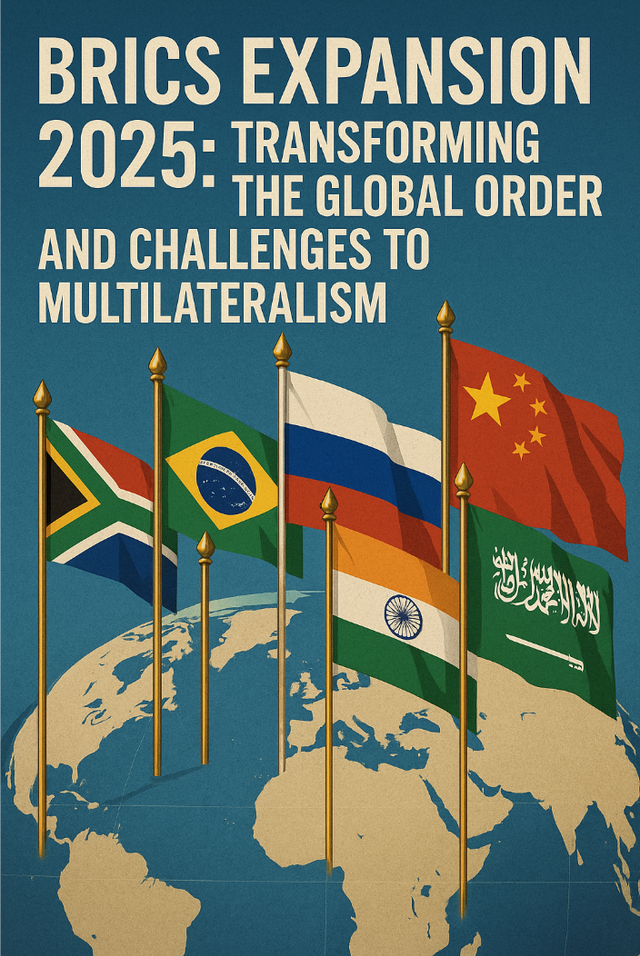
The year 2025 marks a transformative momentum in the architecture of international relations with the significant expansion of the BRICS bloc (Brazil, Russia, India, China, and South Africa). The organization, originally established in 2009 with the premise that international institutions were overly dominated by Western powers and had ceased to serve developing countries, has evolved into an increasingly influential geopolitical and geoeconomic force. In January 2025, Indonesia officially became the tenth full member of BRICS, making it the first Southeast Asian country to join the bloc.
This expansion has positioned BRICS as an entity encompassing roughly half of the global population and more than 41% of world GDP based on purchasing power parity. This phenomenon raises fundamental questions about the future of world order and the relevance of Western-dominated multilateral institutions. This article analyzes the strategic implications of BRICS expansion on global power dynamics, the effectiveness of contemporary multilateralism, and the challenges faced in building consensus among countries with diverse interests.
Expansion Dynamics and Strategic Motivations of New Members
The 2024-2025 Expansion Wave
BRICS expansion began formally on January 1, 2024, with the entry of four new members: Egypt, Ethiopia, Iran, and the United Arab Emirates. The expansion decision was made at the 15th BRICS Summit in Johannesburg in August 2023, with invitations initially extended to six countries, although Argentina decided not to join under President Javier Milei's leadership.
In October 2024, an additional 13 countries were invited to participate as "partner countries," including Algeria, Belarus, Bolivia, Cuba, Indonesia, Kazakhstan, Malaysia, Nigeria, Thailand, Turkey, Uganda, Uzbekistan, and Vietnam. This status allows these countries to engage with and benefit from BRICS initiatives without full membership obligations.
Geopolitical and Economic Motivations
The motivations of countries to join BRICS reflect a desire for diplomatic and economic diversification. Ethiopia, as one of the new members, views BRICS as a platform that promotes economic cooperation and multipolarity, offering an alternative economic and political bloc that is not dominated by a single superpower. Iran sees BRICS as both a geopolitical and economic counterweight to Western dominance, with Ayatollah Ali Khamenei stating the need to eliminate dependence on the dollar in trade.
Indonesia, which became a full member in January 2025, chose full membership after initially being planned as a partner country, reflecting confidence in BRICS' potential to provide a beneficial economic and diplomatic platform. Nigeria, as a partner country, hopes to gain investment in infrastructure projects and access to alternative sources of finance such as the BRICS-owned New Development Bank.
Implications for Global Financial Architecture
De-dollarization Initiatives and Alternative Payment Systems
One of the most significant aspects of BRICS expansion is its focus on 'de-dollarization,' the reduction of dependence on the US dollar in trade. At the 2023 BRICS summit, leaders tasked BRICS' finance ministers and central bank governors 'to consider the issue of local currencies, payment instruments and platforms and report back' to the leaders by the time of the 2024 summit.
These de-dollarization efforts carry significant implications for the United States over the next two decades, potentially leading to decreased demand for US currency and assets, which may have long-term implications for the American economy, including increased borrowing costs and inflationary pressures. The People's Bank of China has concluded bilateral swap agreements with all BRICS+ countries with the exception of Iran and Ethiopia to facilitate local currency usage in trade.
Consensus Challenges and Internal Cohesion
Diversity of Interests and Potential Conflicts
BRICS expansion brings potential conflicts into the group, such as disputes between Egypt and Ethiopia regarding the equitable sharing of the River Nile's water resources, and the longstanding rivalry between Saudi Arabia and Iran in the Middle East. Episodes like this suggest there is far less mortar in the BRICS than advertised, with China often calling the shots and imposing its own vision of expansion over the wishes of its partners.
Despite valid concerns, there are also reasons for comparison with the G7: BRICS+ emerges as a potential alternative, representing the future of economic power and promoting new forms of values and modalities of cooperation. However, the political diversity within the group three democracies (Brazil, India, South Africa) and two non-democratic regimes (Russia, China) limits the group's ability to unite on an anti-Western stance.
Western Response and Strategic Implications
United States and European Positions
White House Press Secretary and White House National Security Advisor have said that BRICS isn't seen as becoming a geopolitical rival, while Treasury Secretary Janet Yellen has largely dismissed BRICS efforts at de-dollarization. The EU as a whole does not have formal relations with BRICS or the expanded BRICS+ as a group, and there is no dedicated BRICS policy or strategy targeting the group as a whole.
The European Parliament in a recommendation of December 13, 2023, recommended that the Council and the EU's High Representative 'respond adequately to China's efforts to build alternative international organizations, including the BRICS group of countries, by ensuring better coordination among the EU Member States'.
Implications for G7 and G20
With the significant economic growth witnessed by BRICS countries, their combined GDP is now larger than that of the G7. If Saudi Arabia decides to join BRICS+, the G20 would include six of the 10 BRICS+ members, with the G20 presidency having been held by BRICS members for three consecutive years: India (2023), Brazil (2024), and South Africa (2025).
Conclusion
The expansion of BRICS in the 2024-2025 period represents a paradigmatic shift in the global order that challenges the hegemony of Western-dominated multilateral institutions. This expansion signifies a shift towards a multipolar world order, although it does not yet directly undermine the memberships of NATO or the OAS. With roughly half of the global population and 41% of world GDP, BRICS+ has become a geoeconomic force that cannot be ignored.
However, significant challenges remain in achieving internal cohesion and effective consensus. The diversity of political, economic, and strategic interests among members ranging from democracies to autocracies, from developing economies to major powers creates complexity in decision-making. BRICS expansion will only increase the coalition's heterogeneity and potential cacophony, despite nominally being a formidable economic bloc.
The potential of BRICS members and partner countries to fulfill their individual aspirations via BRICS hinges on what vision of the future of world order ultimately wins out within BRICS. The long-term implications of BRICS expansion on the international system will depend on the ability of its members to navigate internal differences, build common ground, and leverage their collective strengths to advance shared objectives.
Reference
Carnegie Endowment for International Peace. (2025, March). BRICS expansion and the future of world order: Perspectives from member states, partners, and aspirants. https://carnegieendowment.org/research/2025/03/brics-expansion-and-the-future-of-world-order-perspectives-from-member-states-partners-and-aspirants?lang=en
Nach, M., & Ncwadi, R. (2024). BRICS economic integration: Prospects and challenges. South African Journal of International Affairs, 31(2), 151–166. https://doi.org/10.1080/10220461.2024.2380676
Wikipedia. (2025, June 28). BRICS. https://en.wikipedia.org/wiki/BRICS