
Managing Gaza, Marginalizing Palestine? Indonesia and the Board of Peace

Mahasiswa S-1 Hubungan Internasional, Universitas Sebelas Maret
·waktu baca 6 menit


Tulisan dari Muhamad Ali Akbar tidak mewakili pandangan dari redaksi kumparan
 Perbesar
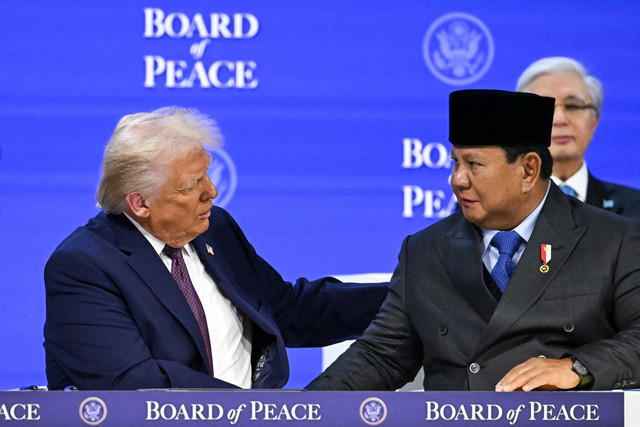
Indonesia’s decision to join the Board of Peace does not automatically represent progress for the Palestinian cause. On the contrary, it raises serious questions about the direction of Indonesia’s foreign policy. This move should not be read as a routine diplomatic step. It goes beyond mere membership in a new forum. It concerns how Indonesia positions itself amid the Palestinian conflict, under the shadow of Trump’s leadership, and at the crossroads of its long-standing free and active foreign policy principle—what Mohammad Hatta once described as Indonesia’s effort to “mendayung di antara dua karang”, navigating between competing powers without being drawn into either.
From the outset, the Board of Peace has been presented as an initiative to halt violence in Gaza. Alongside seven Muslim-majority countries—Turkey, Egypt, Jordan, Pakistan, Qatar, Saudi Arabia, and the United Arab Emirates—Indonesia announced its participation in a forum initiated directly by Trump. Other countries such as Israel, Hungary, Vietnam, Argentina, Morocco, Kazakhstan, and Uzbekistan also joined. China has remained non-committal, while most European countries have openly rejected the initiative. Spain’s Prime Minister Pedro Sánchez, for example, argued that the Board of Peace stands outside the UN framework, raising serious doubts about its credibility as a peace mechanism. In total, more than 25 countries have reportedly expressed willingness to participate.
The Indonesian government, through the spokesperson of the Ministry of Foreign Affairs Vahd Nabyl Achmad Mulachela, stated that the purpose of joining the Board of Peace is to promote the cessation of violence, protect civilians, and expand humanitarian access in Gaza. Normatively, these objectives appear consistent with Indonesia’s long-standing position. The problem, however, lies not in intention, but in the framework and direction of the forum itself.
Concerns emerge when examining more closely what the Board of Peace actually is and who controls it. The Board of Peace is neither a neutral multilateral forum like the United Nations nor the product of a Global South consensus. From the beginning, it has been heavily shaped by Trump’s vision and political style. Peace is narrowly defined as rapid stability rather than as a political process that addresses the root causes of conflict. In the Palestinian context, this approach immediately raises serious doubts.
At this point, President Prabowo’s move can be interpreted as an attempt to break away from Indonesia’s long-standing pattern. For years, Indonesia’s role on Palestine has often stopped at statements and moral appeals. The absence of diplomatic relations with Israel has limited direct dialogue. By entering the Board of Peace—where Israel is also present—Indonesia potentially opens a new channel of communication and, at least theoretically, keeps the two-state solution alive.
But the key question remains simple: so what?
If Jakarta participates without bringing its own agenda, then this membership amounts to little more than symbolism. Dialogue with Israel or Trump does not automatically translate into influence. Without clear agenda setting, Indonesia risks becoming merely a source of moral legitimacy for a project that was never designed to advance Palestinian independence.
This is where the relevance of the free and active principle is tested once again. From the beginning, Indonesia has never positioned itself as merely “neutral.” Soekarno explicitly stated that as long as Palestine remains unfree, Indonesia will continue to oppose Israeli occupation. This stance was not empty rhetoric, but an expression of Indonesia’s historical position against colonialism in all its forms.
For this reason, free and active diplomacy cannot be interpreted as joining every available forum. It means being free to define one’s own position and active in shaping outcomes—not simply following the will of major powers. If Indonesia merely adopts Trump’s framework without correction, its non-aligned posture risks turning into concealed alignment.
These concerns are not unfounded. Former Indonesian Foreign Minister Dino Patti Djalal has warned of multiple red flags that deserve attention. First, the Board of Peace charter lacks a clear reference to Palestine as a political subject and is not fully aligned with UN General Assembly Resolution 2803. Even the term 'freedom', commonly used in U.S. rhetoric, is absent—reinforcing the impression that the Board of Peace prioritizes stability over liberation.
Second, the stance of countries such as Canada, as highlighted by Mark Carney’s criticism of unilateral U.S. approaches, suggests that the Board of Peace is far from objective. Criticism of the United States appears to lead to marginalization, indicating that the forum is more political than normative.
Third, Israel’s membership itself undermines principles of international law. It is difficult to imagine a just peace process when an occupying power sits on equal footing without clear preconditions.
Fourth, even during the Board of Peace inauguration, speeches by key figures such as Marco Rubio, Steve Witkoff, and Jared Kushner focused more on glorifying Trump than on the substance of peace in Gaza. This signals that the Board of Peace is highly personalistic rather than institutional.
Under these conditions, Indonesia must act cautiously and realistically. Several strategic considerations are necessary, as also suggested by Dino. First, Indonesia must always prepare an exit option. If within one or two years the Board of Peace deviates from its core objective—justice and Palestinian independence—Indonesia should not remain trapped for the sake of diplomatic image.
Second, Indonesia possesses valuable experience as a mediator, from Aceh and Timor-Leste to Cambodia. This experience should serve as capital to promote a more inclusive, dialogue-based approach rather than mere military stabilization.
Third, Indonesia’s involvement must not generate security risks, such as military engagement that could provoke direct clashes on the ground. Prudence is essential.
Fourth, narratives such as New Gaza or New Rafah that focus solely on modern cities and physical reconstruction must be critically examined. Development without independence only produces illusory stability.
Fifth, from the outset Indonesia must assert its fundamental difference with Israel’s perspective. If Netanyahu views the Board of Peace as a tool to suppress Palestinian aspirations and reinforce territorial control, Indonesia must stand on the opposite side—affirming that peace cannot be separated from independence.
Ultimately, Indonesia’s membership in the Board of Peace is not a simple matter of right or wrong. What matters is how Indonesia positions itself. If Indonesia participates critically, independently, and with its own agenda, the free and active principle remains intact. But if Indonesia merely follows Trump’s direction, the Board of Peace may become the most serious point of erosion in Indonesia’s diplomatic stance on Palestine.