
This is Why the Board of Peace is Tactically Coherent but Fundamentally Flawed

Mahasiswa S-1 Hubungan Internasional, Universitas Sebelas Maret
·waktu baca 5 menit


Tulisan dari Muhamad Ali Akbar tidak mewakili pandangan dari redaksi kumparan
 Perbesar
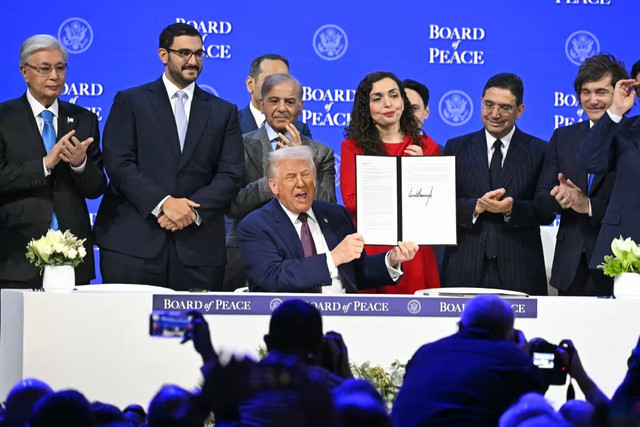
Attacks on Gaza continue to recur, while the United Nations increasingly appears powerless. Resolutions are passed and statements are issued, yet their impact on the ground is barely felt. In this situation, it is understandable that the international public begins to look for shortcuts—something that appears faster, firmer, and less entangled in procedure. Unfortunately, this vacuum is precisely what Trump steps into. He arrives with his trademark style, heavy on claims and deeply personal. Trump speaks about peace as if it were a matter of bold decision-making, rather than a long and complex political process. From this point onward, the Board of Peace is framed as an alternative, as though the Gaza crisis could be resolved through a single negotiating table and one dominant figure.
This way of thinking matters, because it directly shapes the design of the Board of Peace itself. From the outset, the Board of Peace is not intended to address the root causes of the Israel-Palestine conflict. Its focus is far narrower: the creation of short-term stability. In other words, the Board of Peace operates within the logic of negative peace as described by Johan Galtung—halting direct violence without confronting the underlying structures of injustice. This is deeply problematic, because peace without freedom is not a solution but a freezing of the conflict. At this point, the Board of Peace claim to normative legitimacy as a peace instrument begins to erode.
This logic of negative peace does not stand alone. It is reinforced by a broader paradigm: peace through strength. The United States is not only the initiator of the Board of Peace, but also the actor that exercises full control over its direction, mechanisms, and even membership contributions. Peace, within this framework, is not the outcome of consensus, but the result of who holds the greatest coercive power. The Board of Peace therefore does not offer an alternative to hegemony; it represents a new expression of American dominance, repackaged in the language of stability and peace.
When power becomes the primary determinant, the consequences are visible in who is given a voice. Palestine scarcely appears as a full political actor. There is no clear position and no meaningful role. Meanwhile, Israel remains involved through the figure of Netanyahu. This configuration is difficult to interpret as an effort to protect the Palestinian people. What it instead reveals is a familiar pattern, in which those most affected by the conflict are once again pushed to the margins.
This pattern is hardly new in the Middle East. For decades, the region’s future has often been shaped from the outside. The Board of Peace merely continues this tradition. Solutions are designed by external actors and then presented as the best possible path forward, even as local voices remain largely unheard. Experience from other regions shows that such approaches rarely lead to lasting resolution.
At the normative level, the Board of Peace clearly clashes with the principle of self-determination. This principle should be the foundation of any genuine peace process. Yet in practice, it is often treated selectively. As Mark Carney’s candid admission suggests, the so-called rules-based international order operates unevenly. Rules are applied strictly to some actors and loosely to others. Once again, Palestine occupies the disadvantaged position.
This kind of selectivity recalls classical colonial practices. The Scramble for Africa stands as a stark example, where territories were divided and governed without the involvement of the societies that lived there. Within the framework of the Board of Peace, a similar logic reappears in a more subtle form. Palestine is portrayed as something that needs to be pacified and rebuilt, rather than as a political subject with equal standing.
This condition aligns closely with Edward Said’s critique of Orientalism. Palestine is treated as a space of crisis that must be managed, rather than as a political community capable of determining its own future. The Board of Peace speaks extensively about the future of the region, yet Palestinian voices remain largely absent from the process.
Another problem emerges when examining the composition of the Board of Peace itself. Several of its members come from states with authoritarian or illiberal tendencies, such as Saudi Arabia, Qatar, Belarus, and Hungary under Viktor Orbán. It is difficult to expect a credible peace project when values of freedom and participation are not even upheld domestically by many of its members.
Taken together, these factors render the direction of the Board of Peace increasingly unclear. If the aim is to replace or bypass the United Nations, there should be a coherent and consistent agenda. What is visible instead is a heavy dependence on Trump as a political figure and on short-term political maneuvering. The Board of Peace appears more concerned with demonstrating that “something is being done” than with ensuring that what is being done actually addresses the problem.
Ultimately, the Board of Peace can be understood as a tactical move. It operates quickly and appears decisive amid prolonged stalemate. But at a deeper level, it is fundamentally flawed. It ignores the root causes of the conflict, sidelines the principle of self-determination, and reproduces colonial patterns in a new form. Under these conditions, the Board of Peace is not a solution for Palestine and may instead prolong the very problem it claims to resolve.