
Trump’s War on Harvard: How Anti‑Intellectualism Fuels the Culture War?

Mahasiswa S-1 Hubungan Internasional, Universitas Sebelas Maret
·waktu baca 5 menit


Tulisan dari Muhamad Ali Akbar tidak mewakili pandangan dari redaksi kumparan
 Perbesar
Throughout the twentieth century, American universities served not merely as educational institutions but as intellectual engines of state power. During the Cold War, institutions like MIT and Harvard played pivotal roles in shaping U.S. foreign policy through the development of strategic theories, such as game theory for nuclear deterrence, realist international relations theory to justify hegemonic positioning, and later, frameworks like Samuel Huntington’s “Clash of Civilizations” that laid the ideological groundwork for the War on Terror. These were not merely academic exercises. They were powerful epistemic tools that enabled the U.S. government to conceptualize global threats, justify interventionism, and cement its superpower role. In this way, universities were not just sources of knowledge, but of power and it is precisely this intellectual authority that has become a target in the culture wars of the 21st century.
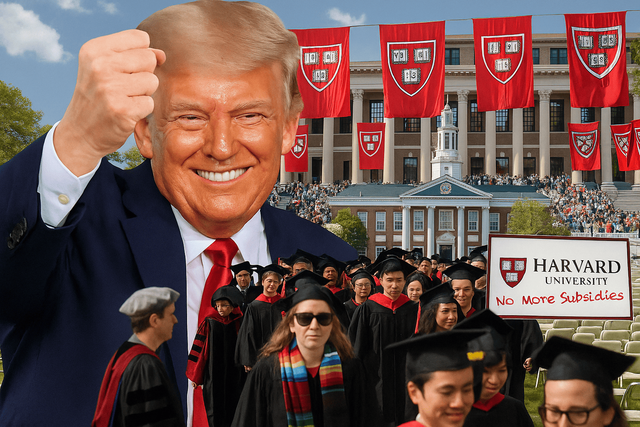
Since returning to office in 2025, Donald Trump has waged an increasingly open campaign against elite universities, Harvard foremost among them. Trump has recast such institutions as ideological threats rather than strategic assets. In April 2025, the Trump administration froze more than $2.2 billion in federal funding to Harvard, citing concerns about antisemitism and ideological radicalism on campus. The Department of Education launched an aggressive investigation, framing the move as a defense of Jewish students and a response to anti-Israel campus activism.
However, critics argue that these actions reflect a broader political agenda. In his speeches, Trump has described Harvard as “a corrupt institution” that “admits people from all over the world who want to tear our country apart.” On June 5, 2025, he issued an executive order banning the issuance of new visas to international students admitted to Harvard, a move he justified on national security grounds. This came despite the fact that nearly 27 percent of Harvard’s student body comprises international students, many of whom contribute to cutting-edge research in fields prioritized by U.S. strategic interests. By portraying international scholars as potential ideological infiltrators, Trump’s rhetoric revives Cold War-style suspicion—but this time aimed not at communists, but at cosmopolitanism itself.
This campaign also intersects with Trump’s broader culture war. By linking pro-Palestinian activism to antisemitism, the administration conflates political dissent with hate speech, a strategy that allows it to penalize universities for hosting divergent views. Although protecting Jewish students is a legitimate concern, Trump’s selective framing has been criticized as a tool to suppress speech critical of U.S. allies, particularly Israel. In this light, the attack on Harvard becomes part of a larger effort to redefine the boundaries of permissible discourse in higher education—by state decree.
At the heart of this assault is a deeply rooted anti-intellectualism. Trump's political brand has long relied on opposition to "experts," "bureaucrats," and "globalists," painting them as out-of-touch elites who threaten the values of ordinary Americans. His administration is populated not by specialists but by loyalists, often lacking the professional or academic qualifications traditionally expected in high office. This shift away from expertise is not incidental—it reflects a political philosophy in which intuition and loyalty override knowledge and competence. As one former Harvard professor noted, Trump is “exploiting a long American tradition of anti-intellectualism,” weaponizing resentment against universities to consolidate support among voters who feel alienated from elite institutions.
In response, Harvard has mounted legal challenges against the administration’s actions. The university sued the federal government over both the funding freeze and the international student visa ban, arguing that these moves violate academic freedom and constitutional protections. Federal courts have issued temporary injunctions in Harvard’s favor, but the legal battle continues. As of late June 2025, Trump announced that his administration was nearing a “very historic deal” with Harvard, though the terms remain unclear. Regardless of the outcome, the damage to the university’s autonomy and to the broader principle of academic independence—may be lasting.
The implications of this confrontation extend far beyond one institution. If the state can selectively withhold funding, restrict immigration, and launch ideological investigations into universities based on perceived political bias, then the intellectual foundation of liberal democracy itself is at risk. Universities have long functioned as spaces for critical inquiry, theoretical innovation, and the development of expertise necessary for effective governance. When these institutions become the target of state suspicion rather than partners in national development, the consequences are profound—not only for science and scholarship, but for democracy, and global leadership.
This war on Harvard, then, is more than a clash of personalities or institutions. It is an epistemic struggle—a battle over who has the right to define truth, shape narratives, and educate future leaders. As courts deliberate, visas hang in limbo, and billions in research funds remain frozen, the stakes grow clearer: in an age of resurgent nationalism and political absolutism, the university stands as one of the last bastions of critical thought. The question is whether the state will continue to see that as a threat or finally remember that its greatest power has often come not from silencing its thinkers, but from listening to them.